Are You a ‘Gritty’ Poker Player?
Some players stick with poker and end up being successful while others drop out and give up the serious pursuit of poker glory.
What separates these two groups of players? To a lesser extent, factors such as natural problem-solving ability; the amount of free time; mental stability; and a few others, but what truly separates the successful from the unsuccessful in poker is grit.
What is Grit?
A player’s grit is their ability to perform at their best over a prolonged period of time while remaining undeterred in the face of setbacks.
In her inspiring book entitled simply: Grit, Angela Duckworth, Ph.D. defines grit as a combination of two factors:
- Sustained Passion
- Resilience
One of the overriding messages from this book is that these attributes can be improved and are normally more important in the journey of most successful people than any natural faculty such as raw talent.
The reason that grit is held to be more important than any other factor is quite intuitive. Nothing good comes easy in life. Poker success is certainly no exception.
Aspiring poker players who lack sustained passion lack the energy to devote large amounts of their time to poker while putting their all into getting better. These people will generally not meet their goals, as they become distracted and disinterested in the game from time to time, thus stagnating, and undoing a lot of their previous progress.
Players who lack resilience fail to cope with the many setbacks that poker inflicts upon its apprentices in the forms of downswings and immense complexity. The result is that they quit before they taste enough success to build a more resilient attitude.
Sustained Passion in Poker
How do you improve your level of sustained passion for poker? The first thing to make clear is that watching the world series on TV and getting inspired at the sight of a well-known professional making a successful hero call down is not sustained passion. Rather, what the amateur experiences upon watching this is a sudden charge of inspiration. While this can be used to get you started, this spark of inspiration can and very often does fade or move into some other field. The way to harness long-term passion in poker is to have a long-term goal that is very meaningful to you deep down. This could be gaining the freedom to take holidays whenever you want and becoming your own boss through making it as a professional player one day. Alternatively, you might want to make enough of a side income to surprise your other half with an exotic holiday. Maybe you want to forge a career out of something you enjoy instead of grinding away in a job that fails to make you happy. For gritty poker players, long-term goals come from the heart.
This long-term meaningful goal should then be supported with a matrix of medium-term goals which are more readily achievable. Focusing on something within reach is a great way to maintain passion in the long term. For you as a player, a medium-term goal could be something like:
‘I’m going to put in 10 hours of study this month and make a document to track my theoretical learning.’
This supports the long-term goal of becoming a strong poker player. Medium goals can, themselves, be supported by short-term goals. Today, my goal is to write for one to two hours. This supports the medium-term goal of finishing the book. The aspiring player’s short-term goal could be to work through a video on PokerStars Learn and take some notes.
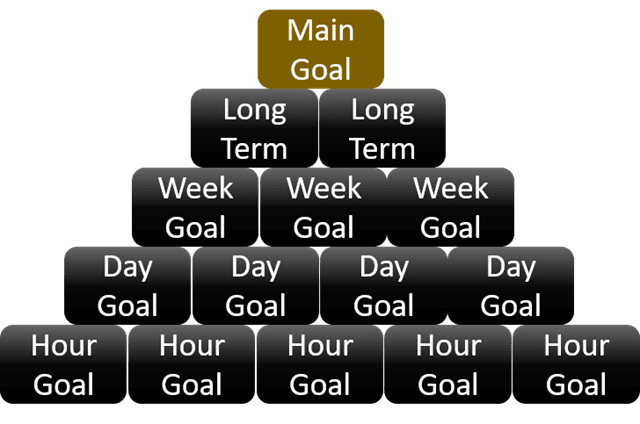
To make the picture more structured you could call goals: hour goals, daily goals, week goals, and long-term goals. These all support your ultimate mission. The overall picture looks like this:
Resilience in Poker
Resilience in poker is all about being able to survive downswings; drops in motivation to play or study; real-life interference; and so on.
The main problem poker players encounter in poker is that their subconscious mind is often unwilling to accept a losing session, day, or week. They feel entitled to win and are easily revolted by unlucky stretches.
In real life, people know that sometimes they will become unwell. They might often get a toothache or catch a common cold. Because these kinds of afflictions are inevitable, they tend to get on with life when they happen. They do not throw tantrums or refuse to get out of bed the next day because they felt poorly the day before. Sometimes they are sick and aren’t at our best, but that does not stop them from trying.
The analogy here is that poker players will inevitably experience periods of bad variance. Just as they don’t expect to never get sick, poker players can learn to accept bad sessions and make the most out of them.
A longer-term losing stretch is harder to stomach, but it may be a sign that you still have too many leaks to be profitable. The truly resilient player uses this diagnosis as fuel to improve. The loss can be a positive for this player as it indicates that he has a lot to work on and this inspires him to work harder on his game.
‘So I’m still not winning…wow, this is difficult – I’m going to crack this come what may!’
Natural drops in motivation are also inevitable due to events both within and outside of poker. The truly resilient player might get distracted for a short amount of time while he deals with real life problems or takes a breather after a downswing, but he comes back, quickly and charged with new determination.
Why do resilient players find the strength to keep coming back when times are tough? Because their end goal is truly important to them. Not only will setting the right end goal help you keep sustained passion for poker, but it will also help you deal with setbacks too. Very few people succeed massively in any field where they possess no interest.
Summary
- Grit is a key factor in poker success.
- Grit is a mixture of sustained passion and resilience during tough times.
- We can improve these attributes and fuel them by forming a meaningful end goal.


View Other Blogs