How to tell a good bad beat story (by a master story teller)
Stories worth telling are about one thing...
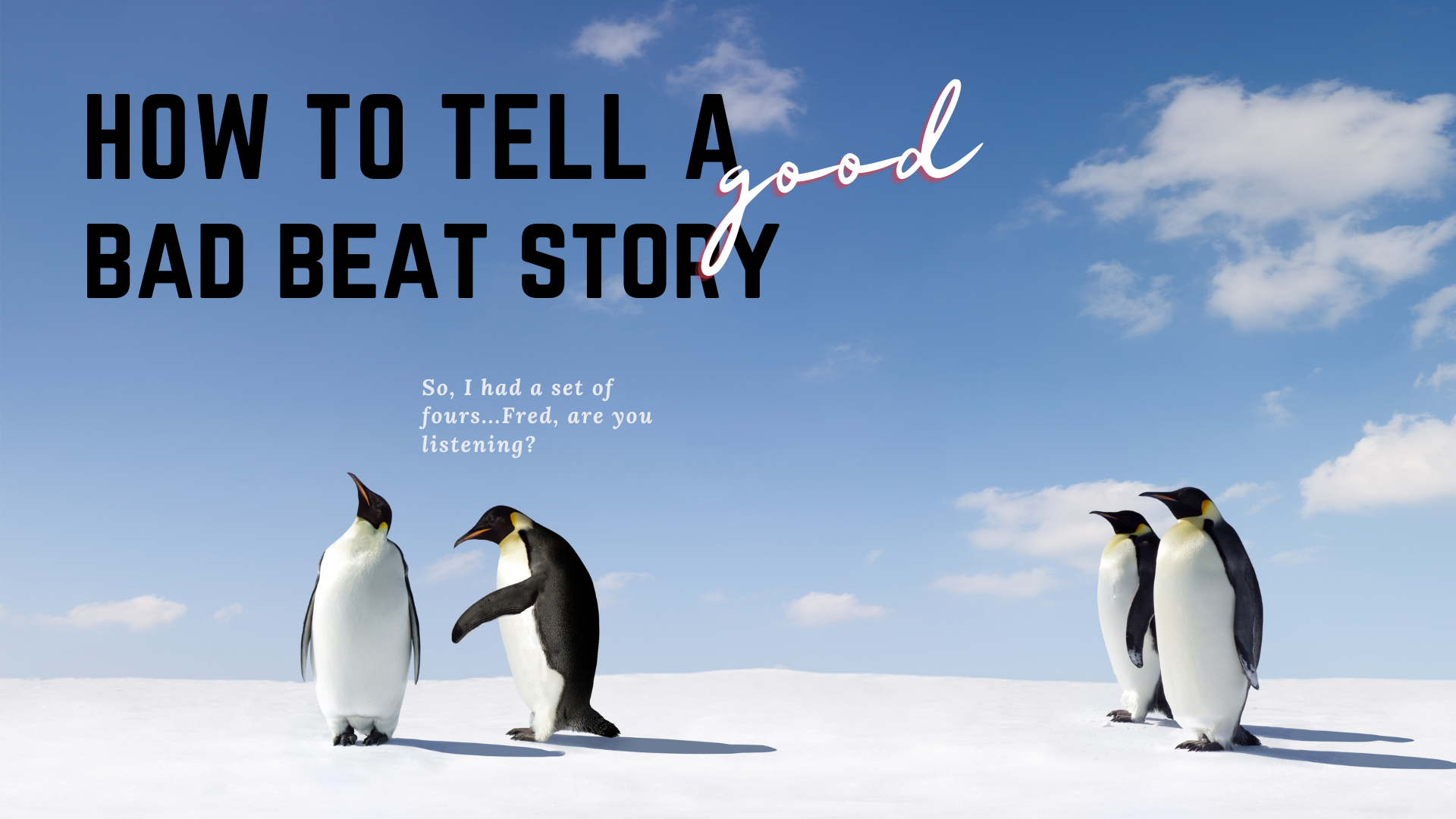
Ever heard a good bad beat story? Neither have we. Here multi-award winning storyteller Matthew Dicks explains what makes a good one, and how you can make your next bad beat less painful (and more entertaining) for the rest of us.
Plus, you’ll never think of the film Titanic in the same way again…
It’s not that bad beat stories are inherently terrible, but as you know, most are…
Over dinner, your friend tells you about getting his pocket aces cracked by runner-runner deuce, and though there is genuine pain in your friend’s voice – because losing money is always painful but especially egregious when we feel like we’ve already earned it – it means nothing to you. It’s like listening to someone tell you about the composition of their fantasy football team or their birdie on the seventeenth hole or, worst of all, their latest Dungeons and Dragons campaign.
None of these things, including your bad beat story, are good stories because they aren’t actually stories.
Most bad beat stories are a simple recounting of a hand. A manifestation of probability. Yes, having aces cracked by runner-runner is lousy, but it also happens about three percent of the time. It’s not exactly a unique event.
Nor is it interesting in any way.
Stories are not statistics. Stories are not unfortunate draws from the mathematical bag of probabilities. They are not opportunities to whine about bad luck and receive reassurances that you played the hand properly.
The Stories Worth Telling Are About One Thing: Change
I used to be one kind of person, but now I’m a different kind of person.
Whether it’s a movie or a book or even a television show, this formula holds true for almost all stories. The most compelling tales are the ones about the ways in which human beings change. These changes take one of two forms:
Transformation or realization.
I was one kind of person, but then something happened, and now I’m a different kind of person.
Or…
I used to think one way, then something happened, and now I think differently.
That’s it. The stories that people want to hear are always about the evolution or devolution of a character. In the case of the bad beat story, that character is you. Large or small, it’s these transformations that are needed for a story to be meaningful to an audience.

Matthew Dicks performing on stage
Bad Beat Stories Can Take Many Forms
For example:
- I used to think that player across the table was an idiot, but it turns out that I was the idiot.
- I thought I owned the table, but then runner-runner deuce reminded me that no one owns anything in poker.
- In thought my future was certain, then this moment at the poker table reminded me that life is random, and nothing should be taken for granted.
- I used to think the universe hated me, but then the idiot across the table hit runner-runner to fill a double gut-shot straight, and I knew it for certain. The universe hates me.
- I used to think that making the right decision was all that mattered, then I turned over the table, threw my beer at the wall, and realized that making the right decision doesn’t mean squat when your opponent busts you on a two-outer.
Stories Should also be Entertaining
If your goal is to recount your bad beat experience to a friend absent any humor, suspense, surprise, and/or some unexpected twist, please don’t.
If you’re not trying to entertain, then you are simply begging for sympathy. Appealing to others to confirm that the universe turned against you on a particular hand.
I’m not a bad player. I just got unlucky. Right?
If this is your goal, stop now. No one likes your stupid bad beat story. No one wants to hear it. At best, they will listen politely because they like you, but eventually, they will stop liking you because sympathy-scrounging is a terrible way to waste someone’s time.
But fear not, intrepid card player. There is a way to tell a bad beat story. There is a way to share your experience without being despised.
Start by counting the number of bad beat stories that you tell. If you have more than half a dozen, you have too many. Every player who plays poker for any length of time will experience bad beats. Many of them. Too many of them. A good storyteller understands that only the best stories should rise to the top and be told.
Not every Bad Beat Story is Worth Telling
Your job us to tell only your best bad beat stories. The ones that are the most entertaining. The ones that are the most unique. The stories that contain the most surprise, suspense, humor, and/or delight.
Yes, I said delight. Your job in telling a bad beat story is not to relieve yourself of some burden. It’s not to confirm that you made the right decision. It’s not designed to serve you in any way.
We tell stories to entertain our audience. To delight them.
This is how a story will ultimately serve us. A well told story will make an audience feel more connected to the storyteller. It will make them want to spend more time in the company of the storyteller. It will make an audience like the storyteller more.
Great storytellers don’t seek sympathy or confirmation that they were wronged. “Woe is me!” is only woe for the audience. Instead, great storytellers strive for connection through authenticity, vulnerability, and the ability to entertain.
Here’s how:
Three Secrets to Telling a Good Bad Beat Story
Stakes: Stories need stakes. You must keep your audience wondering, hoping, wishing, questioning, or rooting for or against you. As the protagonist of your story, you must want or need something. There must be opposition and peril.

Matthew Dicks at The Liar Show
Those stakes cannot simply be chips. If your bad beat story is ultimately the story of how you lost chips or money, no one wants to hear that story. That story is as ordinary as the day is long. Besides, there are far more interesting things at stake at a poker table:
Reputation. Self-confidence. Self-respect. Your winning streak. Your losing streak. Your silent, personal, ongoing war against an opponent. Your ability to return home to your spouse with proof that poker can be your next career move.
One of my favorite bad beat stories involves a hand against a guy who I’ll call Sweeney. Sweeney and I have a love-hate relationship. I know that at his core, Sweeney is a good person. Devoted husband. Great father. Runs a nonprofit that is making a difference in the world. But his desire for fame, his craving for respect, and his consistently inept means of acquiring these things often lead him to annoy me to no end.
“Hey! Can you like my tweet?”
“How about a shout-out on your podcast?”
“Yo! How can I score some free tickets for my friends to your show?”
“Can you record this putt in case it goes in? I’d love to post it on Instagram.”
Sweeney’s heart in in the right place, but his methods suck. As a result, losing to him at the poker table would be devastating. Not only would it cause me to question my ability as a card player, but Sweeney would undoubtedly parlay his unexpected victory into many frustrating attempts at attention-seeking. Social media mentions about his victory. Endlessly repeated references to the bad beat for years. Crediting himself for a smart play when the math dictated that I had the best of it when we both pushed. And since we also work together, my colleagues would undoubtedly be regaled about his victory for years to come.
My bad beat story isn’t about chips or money lost. It’s about the ramifications of such a loss. The human impact to the loss of chips.
These are stakes. This is why losing to Sweeney hurt so much and makes for a good bad beat story.
Characters: Every great story needs good characters. Authentically realized human beings. Your bad beat story can’t be about the cards. The story needs to be about people. Four queens beating aces full of kings is not a compelling story. Even slow rolling four queens against aces full of kings isn’t very entertaining. But if the player sitting across from you is a fully realized human being who your audience can see and know, then the bad beat and the slow roll mean something.
Don’t forget your story needs characters
This is why films, television, and books are at their best when their antagonists are fully realized characters, complete with nuance, realistic motives, and relatability. In my bad beat story, I want you to see Sweeney in your mind’s eye. I want you to have a sense of the man. I want him to echo someone in your own life.
Die Hard is a brilliant film because Bruce Willis plays a likeable, relatable, thoroughly entertaining protagonist, but it’s only because he plays opposite an antagonist as brilliantly realized as Han Gruber that the film soars. Gruber is a fantastic bad guy. Ruthless, amusing, motivated, and even likeable. If Willis was battling nameless, faceless terrorists, the film would forgettable, it’s only when we can see the protagonist and the antagonist as real people that an audience is truly engaged.
In poker, we don’t play the cards. We play our opponents. Stories should be the same. Tell the story of you and your opponent. Not the cards.
Surprise: This last bit of advice might be the most important. Surprise is the best thing that a storyteller can offer an audience. Nothing feels better. Surprise produces the laughter, tears, gasps, and uncontrolled verbal exclamations that make stories great. Surprise is the way that a storyteller produces an emotional response in their audience.
In order to surprise your audience, start by not giving away your story. Don’t let your audience know that you are telling a bad beat story. If you begin your story with, “You’re not going to believe what happened,” I promise you that your audience will not only believe you but will likely not want to hear it.
If you begin your story with, “Want to hear the worst bad beat story of all time?” the answer is no. Perhaps your friend will indulge you to be polite, but why bother telling it? You’ve already given away the story. Yes, there are some details to reveal, but we already know what is going to happen.
Cards will be turned. Chips will be lost. You will be angry.
Instead, begin your story without any of that verbal detritus that ruins the end of so many potentially good stories. Don’t open with a phrase like, “This has to be the worst bad beat of all time.” Save any mention of the bad beat for the moment when it actually happens in the story. Keep your audience wondering if this is the story of a poker victory or a poker defeat.
Wondering is what keeps your audience listening. Wondering is what audiences want to do.
The rule of thumb is this:
When you were surprised within the context of your story, your audience should also be surprised. Bad beats are always surprising. They always shock and dismay us. Even though the possibility of runner-runner deuce exists, the reveal of that second deuce is astounding. Devastating, even.
Don’t deny your audience that same surprise. Don’t steal away that gut punch by giving up the ending in the first sentence.
Titanic is a Bad Beat Story.
One of the reasons that even the most calcified poker player wept at the end of Titanic was because we didn’t think Jack was going to die.
The protagonist hero Jack who saves the day dies because the love of his life won’t slide over two feet so that he could climb on that door. The audience is genuinely surprised that Jack has died in the north Atlantic.
The same holds true for The Sixth Sense. Another bad beat story for a character who finds out only at the end of the film that he is already dead.
Imagine how terrible it would’ve been had you known this secret at the onset of the movie.
Filmmakers understand the importance of surprising their audience. Do the same for your bad beat story by not allowing the audience to see the bad beat coming until the final card falls or the hand is revealed. Allow your loss to be as surprising to your audience as it was to you.
Titanic is also a great bad beat story because it has real stakes. Not only is there a life-or-death battle for survival, but there is also a man trying to win over the heart of a woman. Upper class clashing with lower class.
It also has great characters. Jack and Rose are the characters who we think about in Titanic, but Billy Zane’s portrayal of the upper-class Caledon Hockley (what a name!) is just as important. We despise Zane’s character just as much as we love Jack and Rose, and without him, the story is about man versus sinking boat. Not a bad story, but not nearly as good as including an antagonist who we can despise.
It’s hard to hate an iceberg. It’s easy to hate Zane’s character.
Sweeney beat me in a cash game, busting me twice and forcing me to rebuy. The signature hand was one where the pot was huge. After several raises and re-raises, Sweeney turned over a flush to beat my straight (catching runner-runner clubs to do so) but slunk back in his chair and said, “Two pair.”
He didn’t see the flush. He thought he had lost to my straight.
One of my tablemates, who was reveling in my losses that night, kindly pointed out to the moron that I had lost. And as if on cue, Sweeney shouted, “You never saw it coming!”
Yeah. Neither did he.
As expected, he’s still talking about that night to this day.
Matthew Dicks is a 50-time Moth StorySLAM champion and 6-time GrandSLAM champion whose stories have been featured on their nationally syndicated Moth Radio Hour and their weekly podcast. One of his stories has also appeared on PBS’s Stories From the Stage. You can find out more about him on his website and follow him on Twitter @MatthewDicks.
Latest Articles




View Other Blogs